
How to Choose a C-Shaped Side Table: Height and Sofa Clearance
Check sofa clearance, tabletop height, and available space before choosing a C-shaped side table. Compare the two fixed-height S01 sizes with your own furniture.

To choose a C-shaped side table, measure more than its overall height. Check the tabletop size, the base plate’s thickness and footprint, and the space beneath the tabletop where it will pass over your furniture. The right size depends on the position you want to use, as well as the sofa or chair itself.
This guide explains the measurements and uses Foundation Living’s S01 Small and Medium as a worked example. The S01 has two fixed-height options. It is not a height-adjustable table.
1. Decide where you want the table to sit
Start with your normal sitting position. Do you want the tabletop beside the seat, above part of the cushion, or over a low armrest? These arrangements need different clearances.
If the table stays beside the chair, the base may not need to slide underneath at all. If you want the tabletop closer to your lap, the base needs a clear route under the furniture and the upright needs room beside its edge. A tall or wide sofa arm can stop the table before it reaches the position you want.
For bedside use, measure from the floor to the top of the mattress and check the bed frame below it. Choose the surface height that is comfortable to reach from your own bed.

2. Measure the whole route beneath your sofa
A sofa with tall legs can still have a low central rail, dust cover or reclining mechanism underneath. Measure the lowest point along the route the base would travel, rather than just the visible gap at the front.
- Vertical gap: compare the lowest obstruction with the base thickness, allowing extra room for movement and any floor protection.
- Width between obstructions: check the gap between legs, rails or supports against the base width.
- Available depth: check how far the base can travel before the table’s upright meets the furniture.
- Floor conditions: include rugs, rug edges, uneven flooring and anything added beneath the metal base.
Keep the table away from moving reclining mechanisms. Do not force a base into a tight gap: matching the nominal plate thickness does not confirm that it will move freely.
3. Separate overall height from usable underside height
The overall height tells you where the tabletop surface sits. It does not tell you how much space is available beneath every part of the table.
Three measurements serve different purposes:
- Overall height: helps you compare the surface with your seat, armrest or mattress.
- Floor to the underside of the projecting tabletop: helps when that part of the top needs to pass over a cushion or armrest.
- Floor to a lower brace near the upright: matters if your furniture would reach that part of the frame as you bring the table closer.
The available underside height can therefore change with the table’s position. Do not use one height number as a guarantee for the whole opening.
4. Compare S01 Small and Medium
The S01 C-shaped side table in silver aluminum is available in Small and Medium. Width × depth describes the tabletop viewed from above; height is measured from the floor.
| Size | Tabletop width × depth | Overall height |
|---|---|---|
| Small | 11.81 × 13.78 in 30 × 35 cm |
19.69 in / 50 cm |
| Medium | 13.39 × 15.75 in 34 × 40 cm |
21.65 in / 55 cm |
Medium is 1.97 in (5 cm) higher, with a tabletop 1.57 in (4 cm) wider and 1.97 in (5 cm) deeper. Small offers the lower, more compact surface. Choose between them using your own measurements rather than room size alone.
| Measurement | Small | Medium |
|---|---|---|
| Base plate width × depth | 9.06 × 11.02 in 23 × 28 cm |
10.63 × 12.99 in 27 × 33 cm |
| Base plate thickness | 0.20 in / 5 mm | 0.20 in / 5 mm |
| Floor to underside of projecting tabletop | 19.49 in / 49.5 cm | 21.46 in / 54.5 cm |
| Floor to lower edge of upper brace beside upright | 17.91 in / 45.5 cm | 19.88 in / 50.5 cm |
These approximate base and underside dimensions come from the S01 design model and serve as a measuring reference, not a sofa compatibility guarantee. The base is smaller than the tabletop, and the lower brace beside the upright reduces clearance in that part of the frame.
For example, an armrest lower than the projecting tabletop’s underside may still meet the upper brace if you move the table farther inward. Compare both height and horizontal position. Leave additional clearance rather than planning a contact fit.
Read the side-view dimensions
Small and Medium shown at the same scale in an angled view, so you can see both the tabletop and base. A–D identify different measurement positions; use the listed values when checking your space.
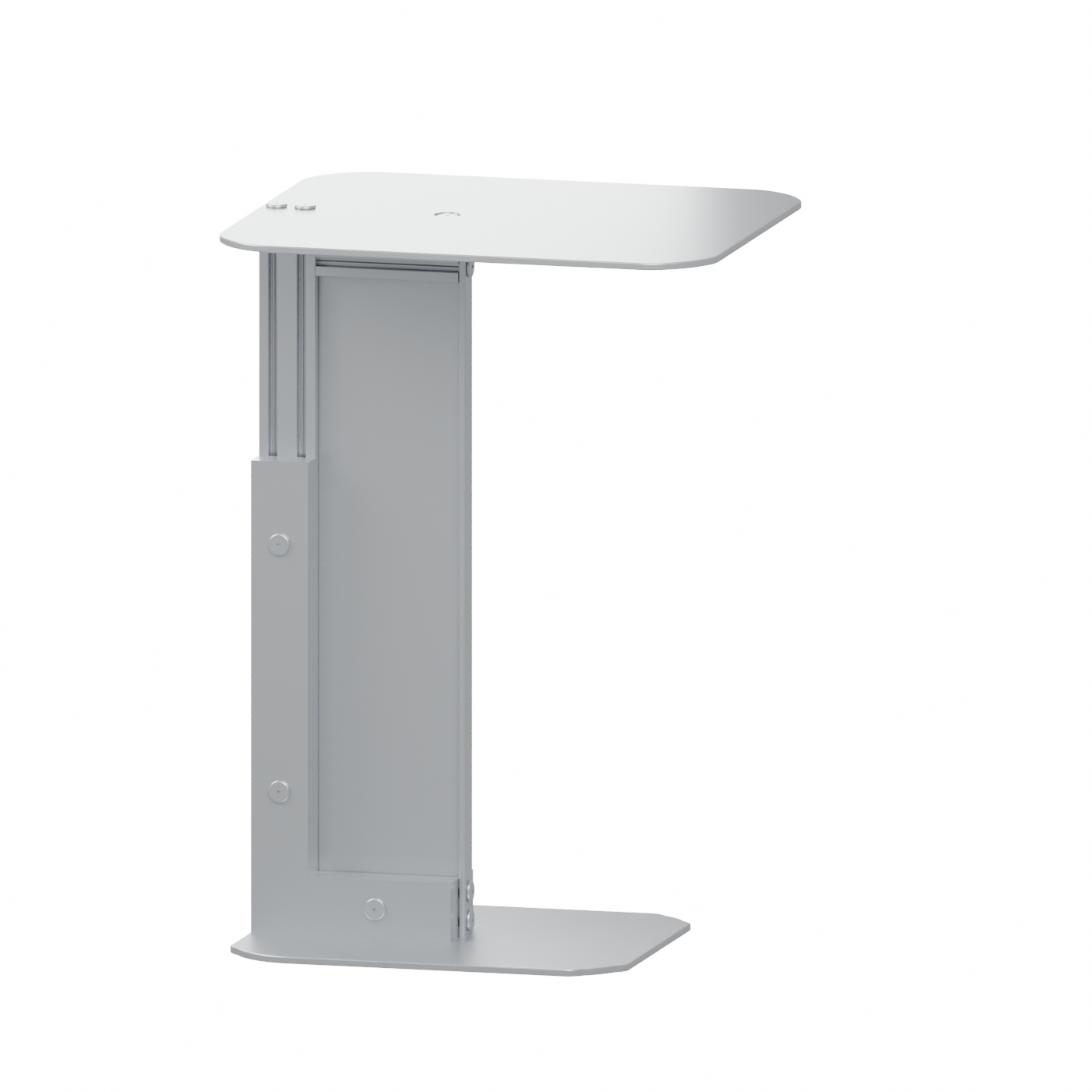
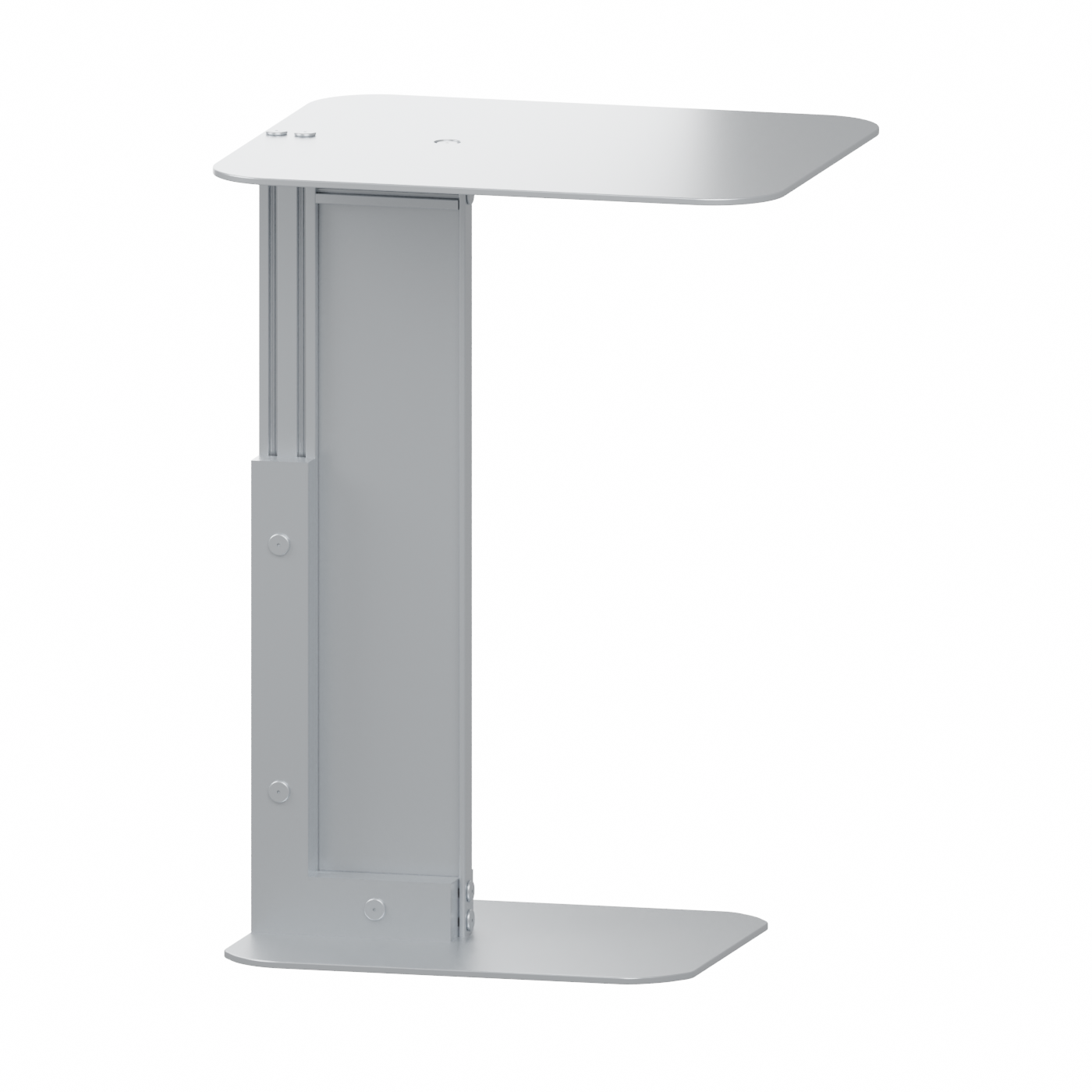
- AOverall nominal height
- S · 50 cm / 19.69 inM · 55 cm / 21.65 in
- BBase plate thickness
- Both sizes 5 mm / 0.20 in
- CFloor to projecting tabletop underside
- S · 49.5 cm / 19.49 inM · 54.5 cm / 21.46 in
- DFloor to upper brace lower edge
- S · 45.5 cm / 17.91 inM · 50.5 cm / 19.88 in
C and D refer to different positions: clearance is lower beside the upright. Check where your furniture would meet the frame, the full base route and extra room for movement. Approximate design references, not a finished-unit or sofa-fit test.
5. Check what you want to put on the tabletop
Measure the items you expect to use together: a book and a drink, for example, or a laptop and mouse. Mark the tabletop footprint on paper to compare Small and Medium without relying on a photograph’s perspective.
If you intend to use a laptop, compare its actual footprint with the table and allow room to handle it safely. A larger top does not by itself establish a higher safe load. Use a stable, level position and do not sit or stand on the table.
The photographs illustrate the table’s appearance and a chair-side arrangement. They do not establish that either size will fit under your particular sofa, and styling objects are not included.

6. Include assembly and floor care in your decision
The S01 has sandblasted aluminum construction with an anodized silver finish and rounded tabletop corners. It arrives partly assembled with four screws and assembly tools. Tighten all four screws securely before use; the S01 assembly video shows the assembly sequence.
The metal base has no feet. On scratch-sensitive flooring, use suitable protection and add its thickness to your clearance calculation. Wipe the table with a soft damp cloth and mild soap, then dry. Avoid abrasive pads and strong cleaners, and dry promptly after outdoor use.
Your measuring checklist
- Choose the position you want beside your sofa, chair or bed.
- Measure the height of the seat, armrest or mattress relevant to that position.
- Check the lowest obstruction along the full route beneath the furniture.
- Compare base width and depth with the available route, not just the front opening.
- Check both the projecting tabletop underside and the lower brace near the upright.
- Include rugs and floor protection, then leave room for movement.
- Compare the tabletop footprint with the items you want to use.
Once you have these measurements, compare S01 sizes and current product details. If the fit is close, contact Foundation Living with your furniture measurements before ordering.
Frequently asked questions
Can any C-shaped table slide under any sofa?
No. The base must clear the furniture along its route, and the upright must be able to reach the position you want. Sofa rails, fabric, legs and reclining mechanisms can all limit placement.
Is a 5 mm sofa gap enough for the S01?
No fit can be confirmed from that number alone. The base plate’s nominal CAD thickness is 5 mm, but the table needs extra room to move, and rugs, floor protection and obstructions affect the available space.
Is Small or Medium better beside a sofa?
Small has a 19.69 in (50 cm) overall height; Medium is 21.65 in (55 cm). Compare the top and underside positions with your seat and armrest, then check the base route. Neither size is universally better.
Does overall height equal the clearance below the tabletop?
No. The tabletop has thickness, and a brace near the upright sits lower still. Use the dimension for the part of the frame your furniture would actually pass beneath.

